
AI Governance for Boards & Executives
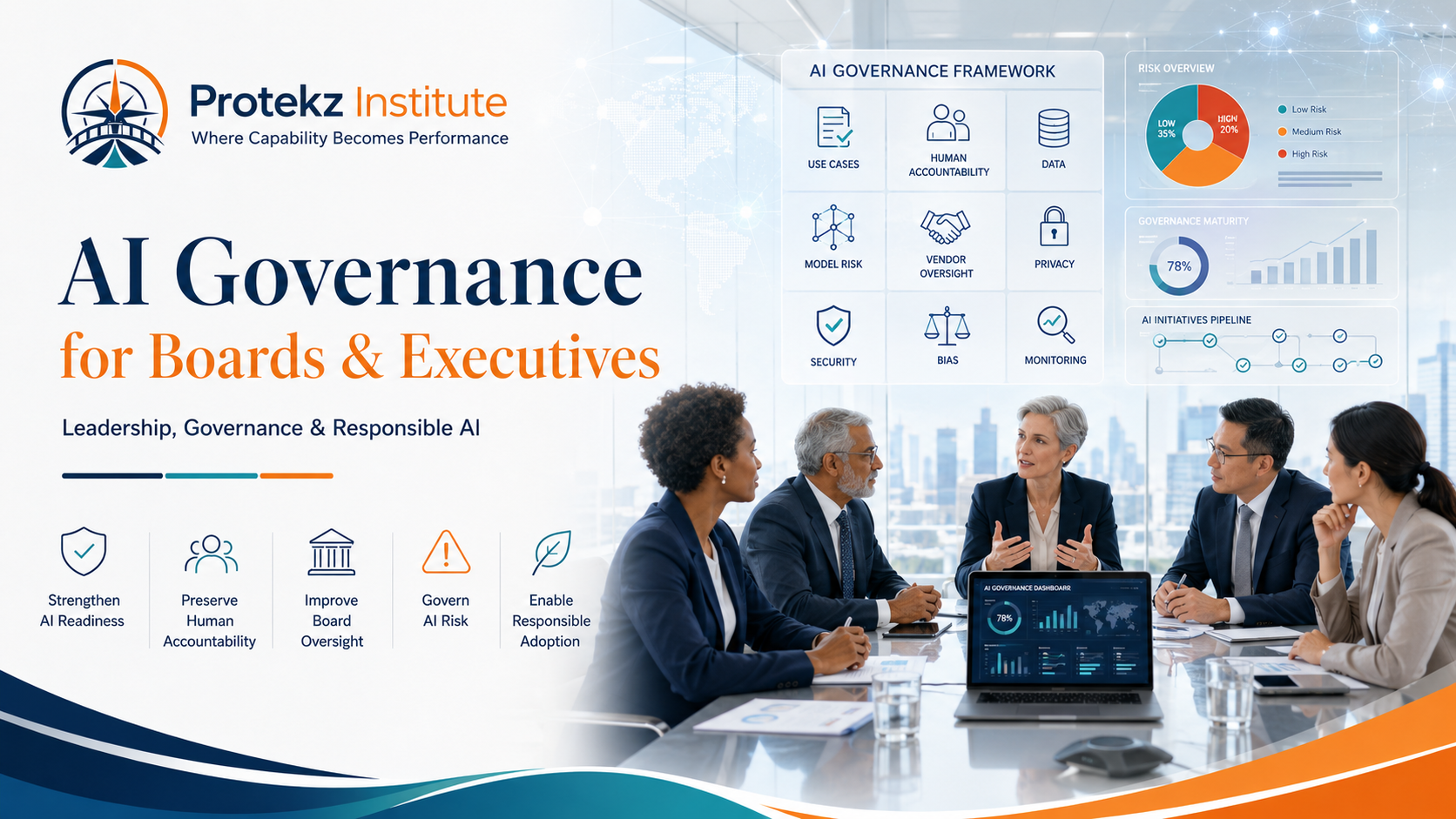
Govern AI before adoption outpaces accountability
1-Day Applied Executive & Board Programme
Executive Briefing | Workshop | Private Cohort
Leadership, Governance & Responsible AI
AI can accelerate analysis, synthesis and decision preparation. It can also introduce new forms of model risk, over-reliance, opacity, vendor dependence, privacy exposure and accountability failure.
The challenge for boards and executives is no longer simply whether to adopt AI.
It is how to capture its value while preserving human judgment, effective oversight and clear accountability.
Why This Programme Matters
AI adoption can move faster than governance.
Organizations are introducing AI into strategy, operations, risk management, customer interaction and executive decision-making.
Yet critical governance questions often remain unresolved:
Which AI use cases genuinely create enterprise value?
Which decisions require stronger human oversight?
Who remains accountable when AI influences a consequential decision?
How reliable are the data, models and outputs?
What level of validation is appropriate?
How should external vendors be governed?
When should an AI-enabled process be challenged, escalated or stopped?
The issue is not simply whether AI works.
It is whether the organization can use AI without weakening judgment, accountability or control.
Programme Overview
AI Governance for Boards & Executives is a practical executive programme focused on governing AI as a strategic and organizational capability rather than treating it solely as a technology initiative.
Participants develop the fluency needed to understand where AI can create value, where its limitations matter and what governance must accompany adoption.
The programme addresses:
AI opportunities and limitations
Use-case governance
Human accountability
Human-in-the-loop thresholds
Data quality and provenance
Model limitations
Validation and assurance
Bias and unintended consequences
Privacy and security
Vendor oversight
Model performance and drift
Decision rights and escalation
Board-level monitoring
Responsible AI adoption
The emphasis is not on turning executives into technologists.
It is enabling leaders to ask better questions, set appropriate boundaries and remain accountable for AI-enabled decisions.
Organizational Impact
Better governance enables more confident AI adoption. Organizations investing in this programme can strengthen performance across several dimensions.
Stronger AI Readiness
Build leadership understanding of where AI can create meaningful value, where limitations matter and what governance is required.
Clearer Human Accountability
Clarify who remains responsible when AI contributes to analysis, recommendations or decisions.
Better Board Oversight
Strengthen board and executive challenge around value, risk, validation, vendors, privacy, security and performance.
More Disciplined Use-Case Selection
Prioritize applications where expected value, organizational readiness and governance requirements are sufficiently understood.
Reduced Unmanaged Risk
Identify data, model, operational, vendor and accountability exposures before they become embedded at scale.
Stronger Strategic Alignment
Connect AI investment and adoption with enterprise strategy, operating reality and measurable outcomes.
What Leaders Will Learn
By the end of the programme, participants will be better equipped to:
Distinguish high-value AI use cases from poorly governed experimentation.
Understand where AI can strengthen analysis, synthesis and decision preparation.
Clarify board, executive, technology and business ownership for AI-enabled decisions.
Set human-in-the-loop thresholds appropriate to consequence, uncertainty and reversibility.
Ask stronger questions about data quality, model limitations, validation and assurance.
Evaluate vendor dependence, privacy, security and bias risks.
Recognize where automation could create over-reliance or weaken human judgment.
Establish practical governance, monitoring and escalation routines.
Connect AI adoption with strategic priorities, enterprise risk and measurable performance.
The AI Governance Discipline
Responsible AI adoption becomes more manageable when boards and executives govern a consistent set of questions.
Define the Use Case
What problem are we asking AI to solve?
Clarify the business objective, expected value and decision context.
Test the Value
Does AI materially improve the current approach?
Distinguish meaningful business value from experimentation driven primarily by novelty.
Understand the Data
What information is the system relying on?
Examine quality, provenance, confidentiality, access and potential bias.
Understand the Model
Where are its limitations?
Identify where outputs may be unreliable, incomplete, opaque or sensitive to changing conditions.
Preserve Human Judgment
Where must people remain meaningfully involved?
Set human oversight according to consequence, uncertainty and reversibility.
Validate & Assure
What evidence gives us confidence that the system is fit for purpose?
Establish appropriate testing, validation, monitoring and independent challenge.
Clarify Accountability
Who remains responsible when AI influences the outcome?
Ensure accountability does not disappear between business, technology, vendors and governance functions.
Monitor & Escalate
What would tell us that the system is no longer performing as intended?
Define indicators, escalation thresholds and conditions for restriction, redesign or withdrawal.
Use Case → Value → Data → Model → Human Judgment → Assurance → Accountability → Monitoring
AI may support the decision. Accountability remains human.
For Boards & Executive Committees
Boards do not need to manage AI systems.
They do need enough fluency to govern how AI affects strategy, risk, performance and organizational accountability.
The programme strengthens oversight around:
Strategic value and materiality
AI risk appetite
Human accountability
High-consequence AI use cases
Model and data risk
Privacy and cybersecurity
Vendor dependence
Bias and unintended consequences
Validation and assurance
Escalation and reporting
Responsible adoption
The objective is not to slow responsible innovation.
It is to ensure adoption does not move faster than the organization's capacity to govern it.
From AI Curiosity to Governed Adoption
Executives also need enough practical exposure to AI to govern it intelligently.
Participants examine how AI can support:
Executive synthesis
Decision preparation
Strategic analysis
Scenario development
Risk framing
Board and meeting preparation
Stakeholder communication
Option comparison
Assumption testing
The purpose is not to teach prompting as an end in itself.
It is to understand where AI can strengthen executive work, where its outputs require challenge and where human judgment must remain decisive.
Who This Programme Is For
AI Governance for Boards & Executives is designed for leaders accountable for technology adoption, strategic oversight and enterprise risk, including:
Boards and board committees
CEOs and executive teams
Strategy leaders
Transformation leaders
Innovation leaders
Digital and technology executives
Risk and governance professionals
Business unit leaders
Senior leaders adopting AI-enabled systems
It is particularly valuable for organizations moving from isolated AI experimentation toward broader enterprise adoption.
Where This Programme Adds the Most Value
The programme is especially relevant when organizations are:
Establishing AI governance
Scaling Generative AI
Using AI for strategic analysis or decision support
Introducing AI into operational workflows
Selecting or managing external AI vendors
Developing enterprise AI policies
Managing sensitive or proprietary information
Defining human-in-the-loop controls
Preparing boards for AI oversight
Evaluating AI-enabled business cases
Moving from pilots to enterprise adoption
Integrating AI into transformation programmes
Practice-Led. Research-Informed. Governance-Focused. Built for Application.
This is not a technical AI course. The programme brings together real-world executive and governance experience, current research and emerging good practice to help boards and senior leaders govern AI with greater confidence, discipline and accountability.
The focus is practical: understanding where AI can create value, where its limitations matter, how risk should be governed and where human judgment must remain decisive.
Executive AI Fluency
Participants develop the practical understanding needed to assess AI opportunities, limitations and failure modes, enabling more informed leadership, challenge and oversight.
Human Judgment & Accountability
The programme reinforces a central principle: AI can support analysis, synthesis and decision preparation, but accountability for consequential decisions remains human.
Research-Informed Governance
Current research on AI governance, human judgment, model risk, organizational adoption and responsible AI is translated into practical questions, frameworks and oversight routines for boards and executives.
Risk-Based Oversight
Governance intensity is matched to the consequence, uncertainty, materiality and reversibility of each AI use case, enabling stronger controls where stakes are higher without unnecessarily constraining lower-risk innovation.
Systems Thinking
AI adoption is examined as an enterprise system spanning strategy, technology, data, people, vendors, risk, governance and operating processes rather than as an isolated digital initiative.
Responsible Innovation
Participants explore how organizations can accelerate adoption where value is clear and risks are manageable, while applying stronger safeguards, validation and human oversight where consequences are more significant.
Applied Executive Learning
Cases, governance scenarios and practical exercises help participants translate principles into decisions, oversight routines and actions they can apply within their own organizations.
For Corporate Teams
Build AI governance around the way your organization is actually adopting AI.
Private cohorts can be tailored to an organization's AI maturity, strategic priorities and emerging use cases.
Customization may include:
Executive AI use cases
Board oversight requirements
AI governance maturity
Human-in-the-loop design
AI-enabled decision processes
Vendor evaluation
Model and data risk
Privacy and security
Responsible AI principles
Use-case prioritization
Governance roles and decision rights
Escalation thresholds
AI dashboards and reporting
90-day responsible adoption roadmap
Private delivery creates space for confidential examination of actual use cases, governance gaps and organizational risks.
Delivery Options
Executive Briefing
A focused session for boards and executive teams requiring practical AI governance fluency, sharper oversight and clearer accountability.
Executive Workshop
An applied one-day programme combining governance frameworks, executive cases, practical AI applications and decision exercises.
Private Corporate Cohort
Dedicated organizational delivery tailored to specific AI use cases, governance priorities and leadership requirements.
Virtual Executive Format
Available as 2 × 3-hour live virtual sessions plus structured pre-work for geographically distributed leadership teams.
Programme Format
Duration: 1 Day
In-Person Format: 8-hour Executive & Board Programme
Virtual Format: 2 × 3-hour sessions + pre-work
Delivery: Executive Briefing | Workshop | Private Cohort
Programme Type: Applied Executive & Board Programme
Pathway: Leadership, Governance & Responsible AI
Certificate: Certificate of Completion
Investment
US$4,995
Public Executive Programme
Includes live programme delivery, applied governance exercises, executive AI cases, programme materials and certificate of completion.
For boards, private corporate cohorts and tailored organizational delivery:
Govern AI Before Accountability Becomes Ambiguous
AI can strengthen analysis, accelerate synthesis and expand the options available to leaders.
But greater capability does not reduce the need for judgment.
AI Governance for Boards & Executives develops the fluency and governance discipline leaders need to capture AI's value while preserving human accountability, effective oversight and enterprise control.
Understand the use case. Test the value. Challenge the model. Preserve human judgment. Govern the risk.
