
Energy Transition Leadership
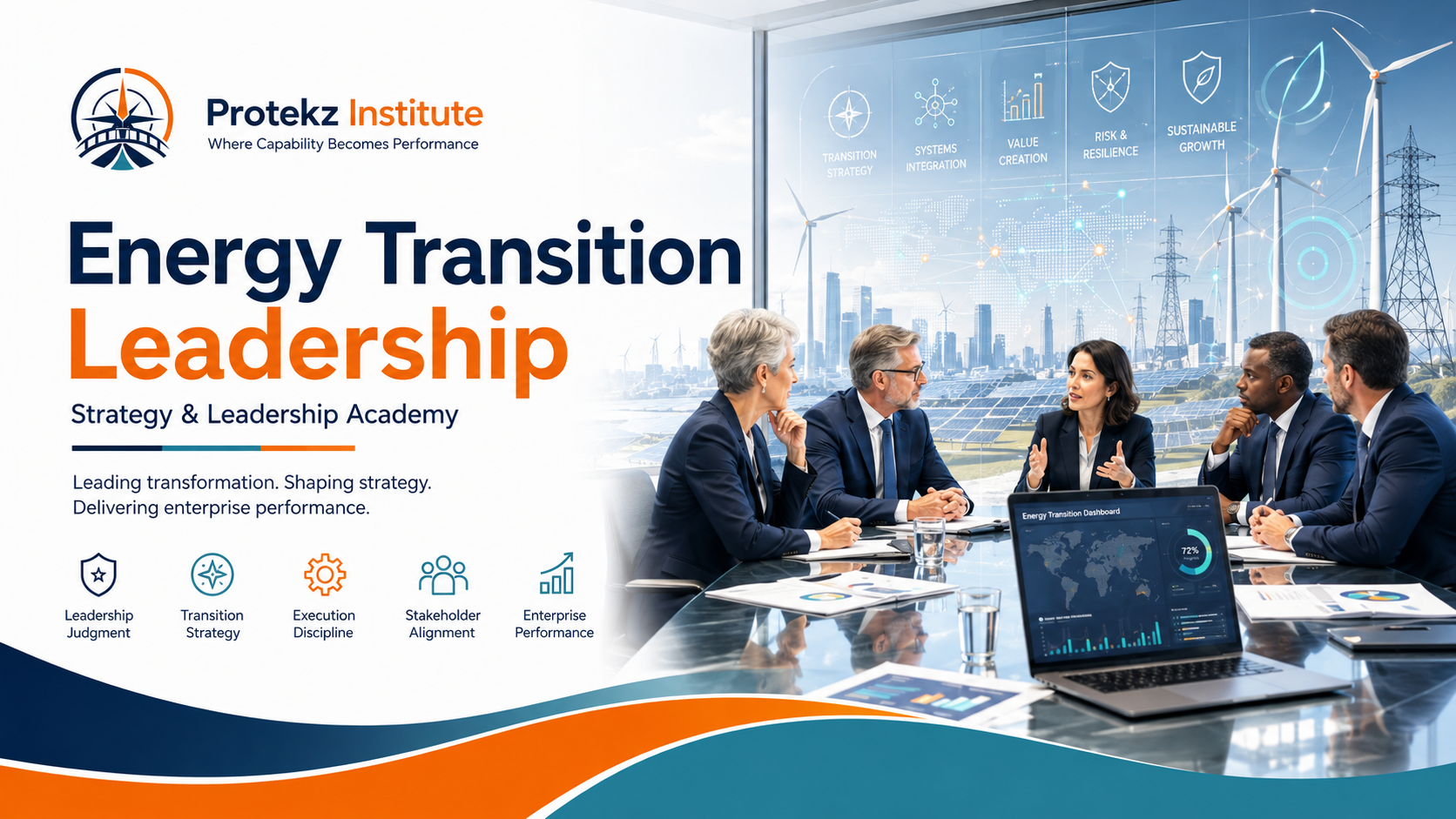
Lead the transition without losing the discipline to perform today
Develop the judgment, organizational alignment and execution capability required to translate energy-transition ambition into credible action while navigating uncertainty, competing priorities and changing operating realities.
3 Days | Applied Executive Programme
Live Virtual | Calgary | Private Corporate Cohort | Executive Workshop
Strategy & Leadership Academy | Leadership, Governance & Responsible AI
Upcoming Cohorts
Live Virtual
March 16–18, 2027
3 Days | Live Interactive Executive Programme
International Cohort
US$3,495
Planning for an executive or transition leadership team?
Calgary In-Person
September 14–16, 2027
Calgary, Alberta, Canada
3-Day Executive Programme
US$3,995
Why This Capability Matters
Energy transition is not simply a technology, policy or capital challenge.
It is a leadership challenge.
Organizations must respond to changing markets, regulation, technology and stakeholder expectations while continuing to protect operational performance, allocate capital responsibly and prepare for an uncertain future.
The difficulty often emerges between ambition and execution.
Transition priorities compete with near-term performance.
Different businesses and functions interpret strategic direction differently.
Technology choices move faster than organizational alignment.
Capital, capability and operational priorities become disconnected.
Transformation fatigue grows.
Accountability becomes blurred across cross-functional initiatives.
The challenge is therefore not simply developing another transition strategy.
It is building the leadership capability required to make choices, align the enterprise and execute through uncertainty.
What Participants and Organizations Gain
Participants strengthen their ability to:
Interpret transition developments through an enterprise leadership lens.
Distinguish external pressure from the strategic choices their organization must make.
Evaluate competing transition pathways without assuming one universal future.
Balance current performance with future positioning.
Make decisions where uncertainty cannot be eliminated.
Align strategy, operations, assets, projects, technology and people.
Identify organizational readiness and capability gaps.
Engage stakeholders without allowing expectations to fragment strategic direction.
Translate transition priorities into accountable execution.
Recognize resistance and transformation fatigue.
Adapt execution as assumptions and conditions change.
Organizations benefit through
Greater Strategic Clarity
Translate broad transition ambition into clearer priorities, choices and organizational implications.
Stronger Enterprise Alignment
Connect strategy with assets, projects, operations, people and investment decisions.
Better Leadership Judgment
Strengthen decision-making where future pathways remain uncertain.
Greater Organizational Readiness
Identify capability, leadership and operating-model gaps before they constrain execution.
Stronger Stakeholder Alignment
Engage competing interests while preserving strategic coherence.
More Disciplined Execution
Convert transition priorities into clear ownership, milestones and performance expectations.
Who Should Attend
Designed for leaders responsible for translating transition direction into organizational decisions and action.
Typical participants include:
CEOs and Executive Leaders
Business Unit Leaders
Asset Leaders
Operations Leaders
Project and Programme Leaders
Strategy Leaders
Transformation Leaders
Energy Transition and Sustainability Leaders
Senior Technical Leaders
Functional Leaders
Emerging Enterprise Leaders
Cross-Functional Leadership Teams
The programme is particularly relevant for leaders sitting between enterprise ambition and operating execution.
Three-Day Executive Learning Journey
Day 1 | Interpret the Transition and Make Strategic Choices
Examine the forces reshaping the energy landscape and distinguish external developments from the strategic choices that matter for the organization.
Work with competing pathways, uncertainty, assumptions, enterprise implications and priority-setting.
Day 2 | Align the Organization and Mobilize Capability
Connect transition ambition with assets, operations, projects, capital, technology, people and organizational capability.
Assess readiness, stakeholder alignment, leadership accountability and the capabilities required to deliver.
Day 3 | Execute, Adapt and Sustain Performance
Translate transition priorities into ownership, initiatives, decisions and milestones.
Examine execution discipline, transformation fatigue, performance signals, learning loops and how to adapt as assumptions or conditions change.
Want the detailed programme?
The Programme Guide provides the complete three-day executive journey, cases, exercises, learning outcomes and programme details.
Applied Executive Learning
Work with transition decisions, not transition slogans
This programme does not assume that every organization should follow the same transition pathway.
Participants examine leadership questions such as:
What does transition actually require from our organization?
Which current capabilities remain critical?
Which new capabilities must be developed?
Where could operating reality undermine strategic ambition?
Which transition initiatives deserve priority?
Where are ownership and accountability unclear?
Which stakeholders materially affect execution?
What assumptions are carrying the greatest uncertainty?
What evidence would cause us to accelerate, slow down or change direction?
The objective is not to predict one future correctly.
It is to develop the leadership capability to perform across changing futures.
The Energy Transition Leadership Discipline
A practical sequence guides the programme:
Interpret → Prioritize → Align → Mobilize → Execute → Engage → Adapt → Learn
Interpret
Understand what is changing and what it means for the organization.
Prioritize
Determine where capital, capability and leadership attention matter most.
Align
Surface conflicting priorities, assumptions and incentives.
Mobilize
Build the technical, organizational and leadership capability required for action.
Execute
Translate strategic intent into clear ownership, milestones and decisions.
Engage
Identify the stakeholders whose support, participation or challenge matters.
Adapt
Monitor assumptions and emerging evidence without allowing flexibility to become strategic drift.
Learn
Use execution experience to strengthen future choices and organizational capability.
From Transition Ambition to Enterprise Execution
Energy-transition strategy moves through several organizational levels.
Boards frame strategic direction and risk appetite.
Executives establish priorities and allocate resources.
Businesses interpret the implications.
Assets and projects make investment and operating decisions.
Functions develop capabilities and systems.
Teams ultimately execute.
Leadership must connect those levels.
Transition performance weakens when they become disconnected.
Why Protekz Institute
Field-to-boardroom transition perspective
Energy transition is approached as an interconnected leadership and enterprise challenge rather than a sustainability topic in isolation.
Systems Thinking
Connect markets, policy, capital, technology, operations, people, stakeholders and governance.
Leadership Under Uncertainty
Provide direction without pretending the future is fully predictable.
Strategic Alignment
Connect transition priorities with investment choices and operating reality.
Organizational Readiness
Assess whether capability, structures, resources and leadership practices can support the strategy.
Execution Discipline
Move from ambition to ownership, decisions, milestones and measurable action.
Stakeholder Leadership
Navigate competing interests while maintaining organizational accountability.
Applied Executive Learning
Work through real leadership tensions, scenarios and transition choices.
Faculty
Mike Etuhoko
Executive Chair & Principal Faculty
Mike Etuhoko brings more than three decades of global energy leadership spanning technical operations, enterprise transformation, governance and executive development.
His work has required navigating complex operating environments where current performance, investment priorities, organizational capability and long-term strategic change had to be considered together.
He is a 2025–26 Society of Petroleum Engineers Distinguished Lecturer on transformational leadership and the energy transition and advises boards, CEOs and executive teams on decision quality, governance, strategy, transition complexity and enterprise performance.
For Corporate and Executive Teams
Build transition leadership around the realities your organization faces
Private cohorts and executive workshops can be tailored around:
Enterprise transition priorities
Portfolio and asset implications
Decarbonization programmes
Emerging energy opportunities
Capital and resource trade-offs
Technology adoption
Organizational readiness
Leadership-team alignment
Stakeholder challenges
Workforce and capability implications
Operating-model requirements
Transformation fatigue
Cross-functional execution
Strategic assumptions and scenarios
Live organizational transition cases
Private delivery gives leadership teams space to examine consequential transition questions using their own strategic context while maintaining appropriate confidentiality.
Programme Details
Duration: 3 Days
Programme Type: Applied Executive Programme
Delivery: Live Virtual | Selected In-Person Cohorts | Private Corporate Cohort | Executive Workshop
Academy: Strategy & Leadership Academy
Pathway: Leadership, Governance & Responsible AI
Certificate: Certificate of Completion
Published Public Programme Investment: US$3,995 - Calgary | US$3,495 - Live Virtual
Choose Your Participation Route
Individual Participant
Join an upcoming public executive programme.
Employer-Sponsored Participant
Need an invoice, purchase order, sponsorship documentation or internal approval information?
Executive or Corporate Team
Apply the programme directly to your organization's transition priorities and leadership challenges.
Lead the Transition. Protect Performance. Build What Comes Next.
Transition leadership is not about choosing between today's operations and tomorrow's ambition.
It is about building the judgment, alignment and capability required to manage both.
Interpret what is changing.
Prioritize what matters.
Align the organization.
Mobilize capability.
Execute with discipline.
Adapt as evidence changes.
