
Strategic Management for Enterprise Performance
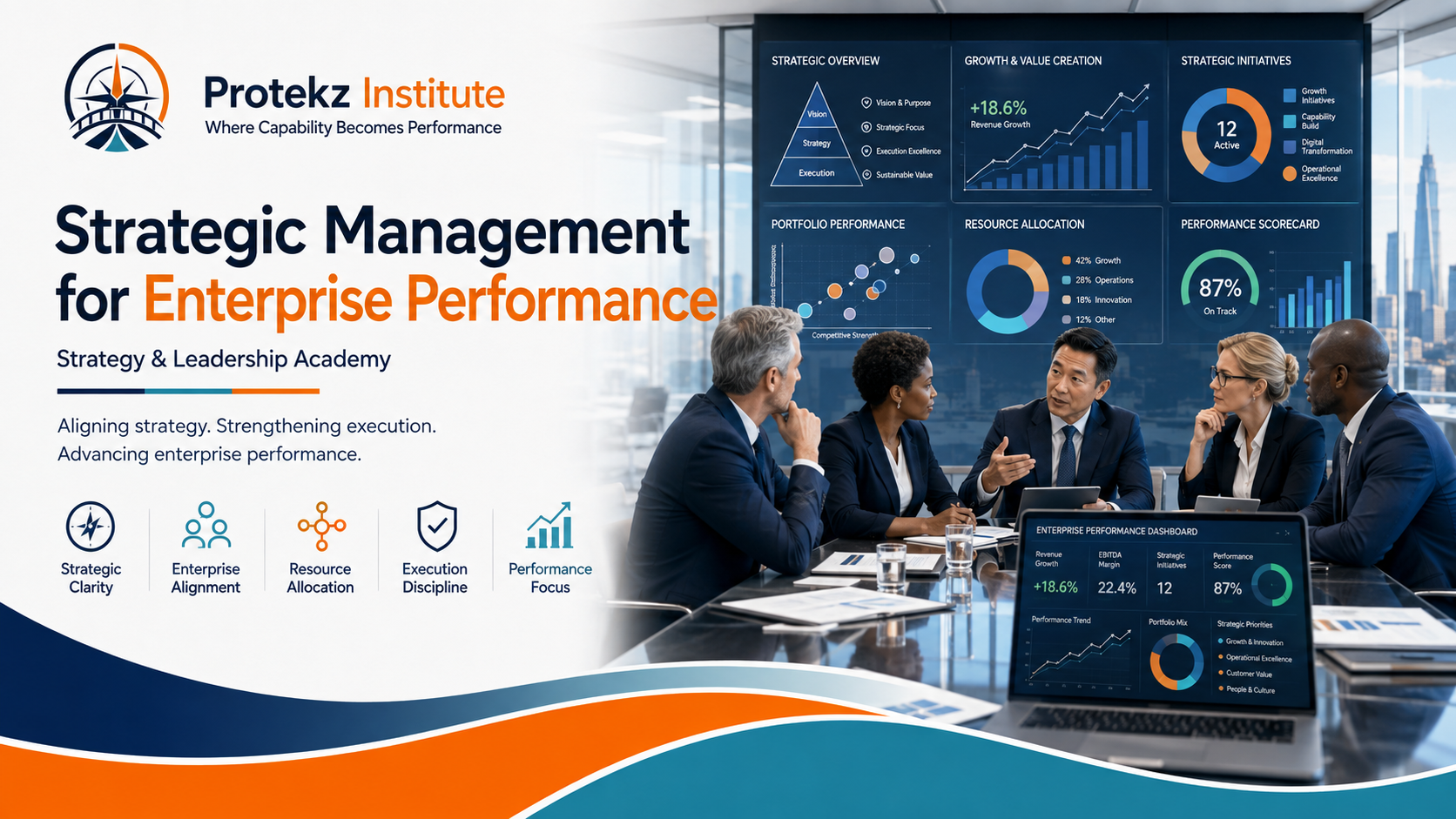
Turn strategic priorities into enterprise performance
Strengthen the capability to make sharper strategic choices, align resources and organizational priorities, translate direction into disciplined execution and adapt as conditions change.
5 Days | Applied Strategic Management Programme
Live Virtual | In-Person / On-Site | Corporate Cohort
Strategy & Leadership Academy | Leadership, Governance & Responsible AI
Upcoming Cohort
Live Virtual
May 17–21, 2027
5 Days | Live Interactive Programme
International Cohort
US$4,495
Planning for an executive or management team?
Why This Capability Matters
Organizations rarely struggle because they have no strategy.
They struggle when there are too many priorities, capital and resources remain tied to yesterday's assumptions, businesses interpret enterprise direction differently, accountability fragments and execution becomes disconnected from strategic intent.
Under these conditions an organization can become strategically busy without becoming strategically effective.
The challenge is therefore not simply producing a better plan.
It is building the management discipline required to convert strategic choices into coordinated action, measurable performance and sustained enterprise value.
What Participants and Organizations Gain
Participants strengthen their ability to:
Assess changing strategic conditions and their implications.
Distinguish genuine strategic choices from goals and aspirations.
Make explicit trade-offs when priorities compete.
Translate enterprise strategy into clearer business and functional priorities.
Test the assumptions underlying strategic choices.
Align capital, resources and organizational capability with strategic intent.
Identify structures, incentives and decision rights that undermine execution.
Strengthen accountability for strategic initiatives.
Connect strategic priorities with meaningful performance measures.
Diagnose execution gaps earlier.
Conduct more effective strategic performance reviews.
Adapt strategy without creating strategic drift.
Organizations benefit through:
Greater Strategic Clarity
Separate the few choices that matter most from an expanding portfolio of initiatives.
Better Resource Alignment
Connect capital, people, capability and leadership attention more directly with strategic importance.
Stronger Enterprise Alignment
Reduce fragmentation across businesses, functions, assets and projects.
More Disciplined Execution
Translate strategic direction into ownership, initiatives, milestones and decision requirements.
Better Performance Visibility
Understand whether execution is producing the strategic outcomes intended.
Greater Adaptability
Recognize when assumptions have materially changed and determine when priorities should change with them.
Who Should Attend
Designed for leaders whose decisions influence strategy, resources, organizational execution or enterprise performance.
Typical participants include:
Executives and Senior Leaders
Business Unit Leaders
Country and Regional Leaders
Asset Leaders
Functional Heads
Strategy Leaders
Operations Leaders
Transformation Leaders
Project and Portfolio Leaders
Senior technical leaders moving into broader enterprise responsibility
High-potential leaders preparing for general-management roles
The programme is especially valuable for leaders responsible for decisions that cut across multiple functions, material resources or enterprise-level outcomes.
Five-Day Learning Journey
Day 1 | Strategic Context and Choice
Interpret changing markets, regulation, technology, competition, stakeholders and operating realities.
Distinguish strategic choices from broad ambitions and clarify where the organization intends to create value.
Day 2 | Priorities, Assumptions and Trade-Offs
Translate strategic choices into a limited number of enterprise priorities.
Examine strategic assumptions, uncertainty, competing objectives and the discipline of deciding what the organization will not pursue.
Day 3 | Resources, Capabilities and Organization
Connect strategy with capital allocation, people, technology, strategic capability, operating-model choices and leadership attention.
Identify where organizational design or incentives may work against strategic intent.
Day 4 | Execution and Accountability
Translate strategic priorities into initiatives, ownership, decision rights, milestones and cross-functional dependencies.
Examine the governance and management disciplines required for execution.
Day 5 | Performance, Review and Adaptation
Connect strategic intent with meaningful performance measures.
Learn how to diagnose execution gaps, review strategic progress and adapt when assumptions or external conditions materially change.
Applied Learning
Strategy is tested through decisions
Participants work with cases, enterprise scenarios, prioritization exercises and strategic-management decisions rather than studying frameworks in isolation.
Typical leadership questions include:
Are our strategic priorities genuinely clear?
What are we choosing not to do?
Which assumptions carry the greatest strategic risk?
Do our resource decisions reflect our stated priorities?
Which capabilities are essential to our strategy?
Where is organizational complexity weakening execution?
Which strategic initiatives should be accelerated, redesigned or stopped?
What evidence should cause us to reconsider a strategic choice?
The test of strategy is not whether it sounds compelling.
It is whether it changes organizational decisions and improves performance.
The Enterprise Performance Discipline
The programme uses a practical strategic-management sequence:
Interpret → Choose → Prioritize → Align → Allocate → Execute → Perform → Adapt
Interpret
Identify the external and internal developments that materially affect enterprise performance.
Choose
Clarify where the organization will compete, invest and differentiate.
Prioritize
Translate strategic choices into a manageable number of enterprise priorities.
Align
Ensure structures, capabilities, incentives and decision rights support the chosen direction.
Allocate
Connect capital, people, technology and leadership attention with strategic importance.
Execute
Translate priorities into accountable action.
Perform
Use evidence to determine whether strategy is producing the intended outcomes.
Adapt
Revisit assumptions and priorities when conditions materially change.
Strategy becomes meaningful when these disciplines operate as one management system.
From Strategic Intent to Enterprise Performance
Enterprise performance requires strategy to influence decisions at every level.
Enterprise
Where will we create value?
Business
What does enterprise direction require from each business or operating unit?
Portfolio
Where should capital and capability be concentrated?
Assets & Projects
Which investments and initiatives matter most?
Functions
What capabilities, systems and support must change?
Teams
What must people execute differently?
Strategic management connects these levels.
Why Protekz Institute
Strategy viewed through execution
This is not a conventional strategy course built around frameworks alone.
Enterprise Perspective
Examine strategy across markets, capital, operations, technology, people, governance and performance.
Strategic Choice
Distinguish real choices from broad aspirations and examine where strategic discipline requires saying no.
Resource Alignment
Connect strategic priorities directly with capital, capability and leadership attention.
Systems Thinking
Understand how decisions in one part of the enterprise create consequences elsewhere.
Execution Discipline
Translate strategy into ownership, milestones, dependencies and decision requirements.
Performance Focus
Use performance measures to understand whether strategic intent is actually producing enterprise outcomes.
Applied Learning
Work through real resource tensions, execution challenges and enterprise decisions.
Faculty
Mike Etuhoko
Executive Chair & Principal Faculty
Mike Etuhoko brings more than three decades of international experience spanning operational leadership, strategy, enterprise transformation, governance and leadership development.
His experience includes leading complex organizational and capability transformations in global energy environments and working across executive leadership, operational teams, partners, governance stakeholders and regulators.
He is a 2025–26 Society of Petroleum Engineers Distinguished Lecturer and advises executives and boards on decision quality, strategy, transformation, governance and enterprise value.
For Executive and Corporate Teams
Strengthen strategic management around the priorities your organization actually needs to deliver
Private cohorts may be tailored around:
Corporate or business-unit strategy
Current strategic priorities
Portfolio choices
Capital-allocation decisions
Growth priorities
Enterprise transformation
Energy-transition strategy
Responsible AI and technology priorities
Operating-model changes
Leadership-team alignment
Strategic capability gaps
Performance-management systems
Strategic initiative portfolios
Cross-functional execution
Live organizational strategy cases
This enables an intact leadership team to develop shared strategic disciplines while applying them to its own priorities.
Discuss a Private Corporate Cohort
Programme Details
Duration: 5 Days
Programme Type: Applied Strategic Management Programme
Delivery: Live Virtual | Private Corporate Cohort | In-Person / On-Site
Academy: Strategy & Leadership Academy
Pathway: Leadership, Governance & Responsible AI
Certificate: Certificate of Completion
Public Live Virtual Investment: US$4,495
Choose Your Participation Route
Individual Participant
Join the upcoming international cohort.
Employer-Sponsored Participant
Need an invoice, purchase order, sponsorship information or documentation for internal approval?
Executive or Corporate Team
Apply the programme to your own strategic priorities and enterprise-performance challenges.
Strategy Must Become Performance.
A strategy can be analytically sound and still fail to create value. What matters is what happens after the choice is made.
Are priorities clear?
Do resources follow them?
Does the organization understand what must change?
Is accountability visible?
Can performance be seen early enough to intervene?
Can the organization adapt without losing direction?
Develop the strategic-management discipline required to choose deliberately, prioritize clearly, align the enterprise and execute accountably.
