
Formation Damage & Well Underperformance
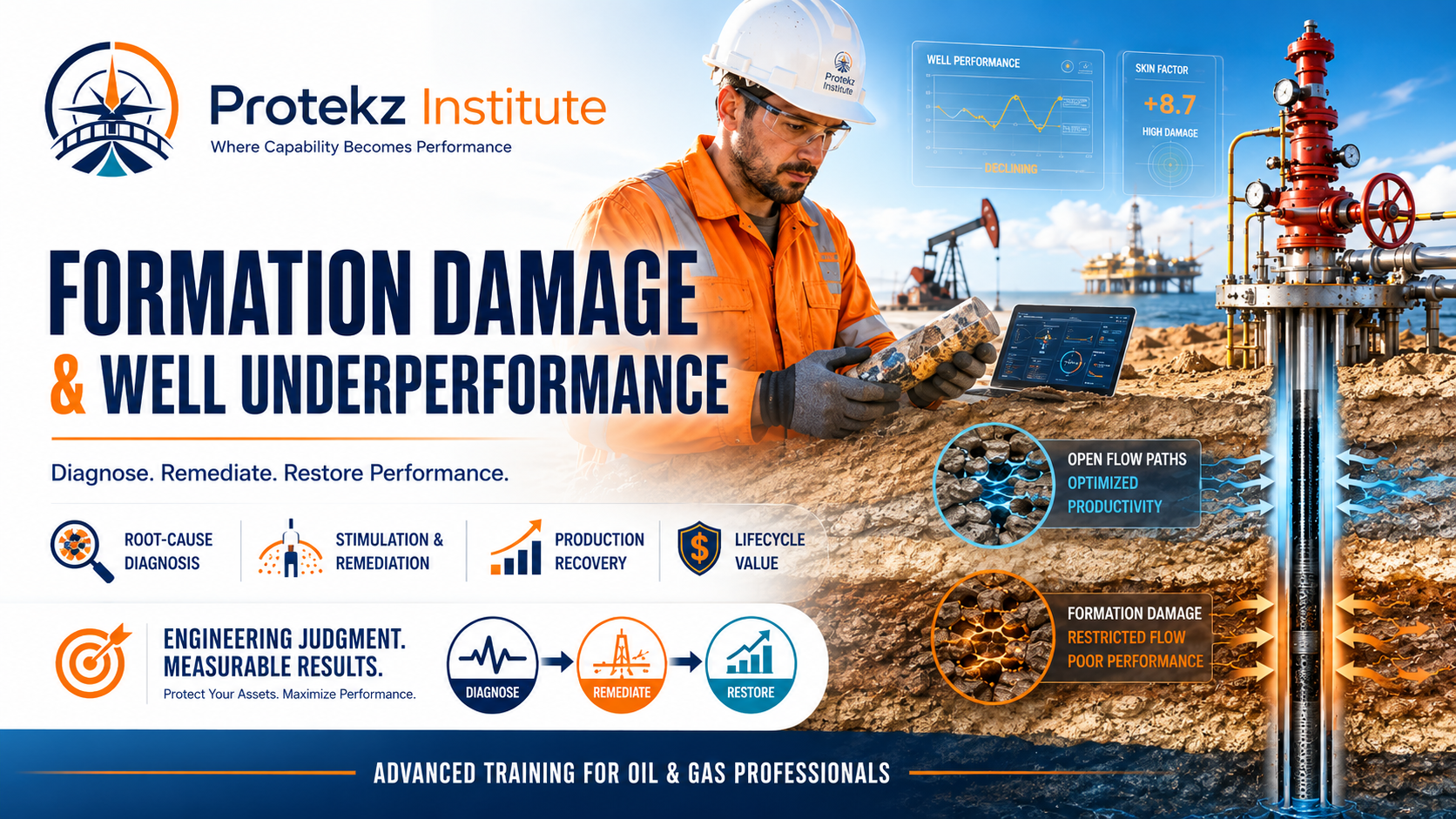
Diagnose the cause. Restore productivity. Protect long-term asset value.
A five-day applied programme for strengthening diagnostic judgment, treatment selection and intervention decisions across underperforming wells and complex production systems.
5 Days | Advanced | Applied Technical Programme
Live Virtual | In-Person | Private Cohort
UPCOMING COHORTS
Live Virtual
June 21–25, 2027
5 Days | 5 Live Hours per Day
Americas | EMEA | APAC
US$4,495
Planning for a team?
Private cohorts and tailored corporate delivery are available.
Calgary
March 8–12, 2027
Calgary, Alberta, Canada
5 Days
US$4,995
Why This Capability Matters
Underperformance is a diagnosis problem before it is a treatment problem.
A declining production rate confirms that something has changed. It does not establish why.
The constraint may sit in the reservoir, near-wellbore region, completion, production system, flow assurance or previous intervention history.
Weak diagnosis can lead to poor stimulation candidates, repeated remediation, unnecessary intervention cost and limited production recovery.
The stronger approach is to establish the performance gap, test competing explanations and intervene only when the evidence, technical feasibility and value potential justify action.
What Participants and Organizations Gain
Participants strengthen their ability to:
Differentiate formation damage from reservoir, completion and production-system constraints.
Diagnose major formation damage mechanisms and sources.
Interpret skin, productivity and production behaviour in context.
Connect laboratory evidence with field decisions.
Evaluate sandstone and carbonate stimulation options.
Assess hydraulic-fracturing candidates.
Evaluate integrity and execution constraints before intervention.
Diagnose scale, wax, asphaltenes, hydrates and water or gas production problems.
Evaluate treatment effectiveness through post-intervention performance.
Organizations benefit through:
Stronger Diagnostic Discipline
Improve root-cause identification before treatment selection.
Fewer Low-Value Interventions
Reduce trial-and-error stimulation and repeated remediation.
Better Treatment Readiness
Improve candidate selection and clarify intervention objectives.
Improved Production Efficiency
Restore performance through more disciplined and evidence-based intervention decisions.
Five-Day Learning Journey
The programme moves progressively from identifying impairment to selecting interventions and learning from the production response.
Day 1 | Formation Damage Mechanisms, Skin & Productivity
Formation damage mechanisms, sources of impairment, skin, productivity impact and diagnostic evidence.
Day 2 | Laboratory Diagnostics & Sandstone/Carbonate Stimulation
Core-flood and compatibility testing, sandstone stimulation, carbonate stimulation, laboratory evidence and candidate evaluation.
Day 3 | Matrix Treatment Design & Hydraulic Fracturing
Treatment design methodology, fluid selection, placement strategy, candidate economics and hydraulic-fracturing fundamentals.
Day 4 | Sand Control Stimulation & Field Application
Sand-production mechanisms, perforation, gravel and screen selection, field applications and lifecycle implications.
Day 5 | Production Problems, Flow Assurance & Post-Intervention Learning
Scale, wax, asphaltenes, hydrates, water and gas production problems, treatment evaluation and project presentations.
Want the detailed technical content?
The Programme Guide provides the complete five-day curriculum, calculations, laboratory applications, stimulation design topics, cases and learning project.
Applied Learning
Diagnose It. Test It. Select the Intervention. Learn from the Response.
This programme develops diagnostic capability rather than teaching stimulation technologies in isolation.
Participants work with calculations, production histories, laboratory evidence, field cases and treatment decisions.
The Well Stimulation Team Project requires participants to:
Diagnose → Test the Evidence → Select the Intervention → Defend the Decision → Evaluate the Response
Teams develop a treatment or remediation proposal only where the evidence supports intervention.
Private cohorts may substitute client wells or asset-specific production challenges.
Who Should Attend
Designed for professionals whose decisions affect well productivity, treatment selection and production restoration.
Core Technical Participants
Production Engineers and Technologists
Reservoir Engineers
Stimulation Engineers
Completion Engineers
Well Intervention Engineers
Petroleum Engineers
Well Performance specialists
Production Chemistry specialists
Leadership & Cross-Functional Participants
Field Development Engineers
Technical Assurance professionals
Project Evaluation professionals
Production and Intervention Managers
Completion and Stimulation Managers
Technical Authorities
Asset Managers
Operations Leaders
Particularly relevant for:
Underperforming wells | Mature assets | Stimulation candidates | Production optimisation | Multidisciplinary diagnostic teams
Why This Programme
Diagnosis Before Treatment
The programme begins with understanding the performance problem, not choosing the intervention.
Root-Cause Discipline
Participants test competing explanations using multiple sources of evidence.
Field Application
Real operating cases, calculations and production challenges support application.
Integrated Thinking
Reservoir, formation, completion, production, integrity and intervention factors are considered together.
Learning from the Response
Post-treatment performance becomes part of the diagnosis and continuous learning cycle.
Future-Ready Technical Capability
Digital diagnostics, data analytics, AI-enabled decision support, real-time monitoring and evolving treatment technologies can strengthen well-performance decisions.
The principle remains simple:
Technology should strengthen engineering judgment, not replace it.
The programme also connects relevant formation behaviour, injectivity and near-wellbore principles with emerging subsurface applications where technically appropriate.
What Participants Value
“Mike provided many good real-life examples and in-class exercises to illustrate concepts. Very helpful.”
Technical Account Executive, Stimulation
“Course content was well structured and immediately applicable to our wells.”
Development Engineer
“Very practical approach to diagnosing and mitigating well underperformance.”
Completion & Intervention Manager
Faculty
Michael Etuhoko
Executive Chair & Principal Faculty | 2025–26 SPE Distinguished Lecturer | Former Global Head of Completion & Well Integrity
Michael Etuhoko brings more than 35 years of international experience spanning well engineering, stimulation, completion, intervention and production performance.
His experience includes HPHT, H₂S and CO₂ environments, sand control, hydraulic fracturing and complex offshore and onshore assets through senior roles with TotalEnergies, Shell, KPO and HCML.
Programme Details
Duration 5 Days
Level Advanced
Type Applied Technical Programme
Delivery Live Virtual, In-Person or Private Cohort
Certificate Certificate of Completion
Pathway Energy & Technical Capability
Academy Energy Academy
Investment
Calgary In-Person: US$4,995
Live Virtual: US$4,495
Future Cohorts
2027
March 8–12 | Calgary In-Person
Jun 21–25 | Live Virtual
Choose Your Participation Route
Individual Participant
Develop stronger diagnostic and intervention judgment.
Employer-Sponsored Participant
Need an invoice, purchase order or internal approval documentation?
Corporate Team
Use client wells, production challenges or stimulation candidates to build shared diagnostic capability across your team.
Diagnose before you treat.
Build the technical judgment to determine why wells underperform, identify when intervention is justified and restore production with greater discipline.
